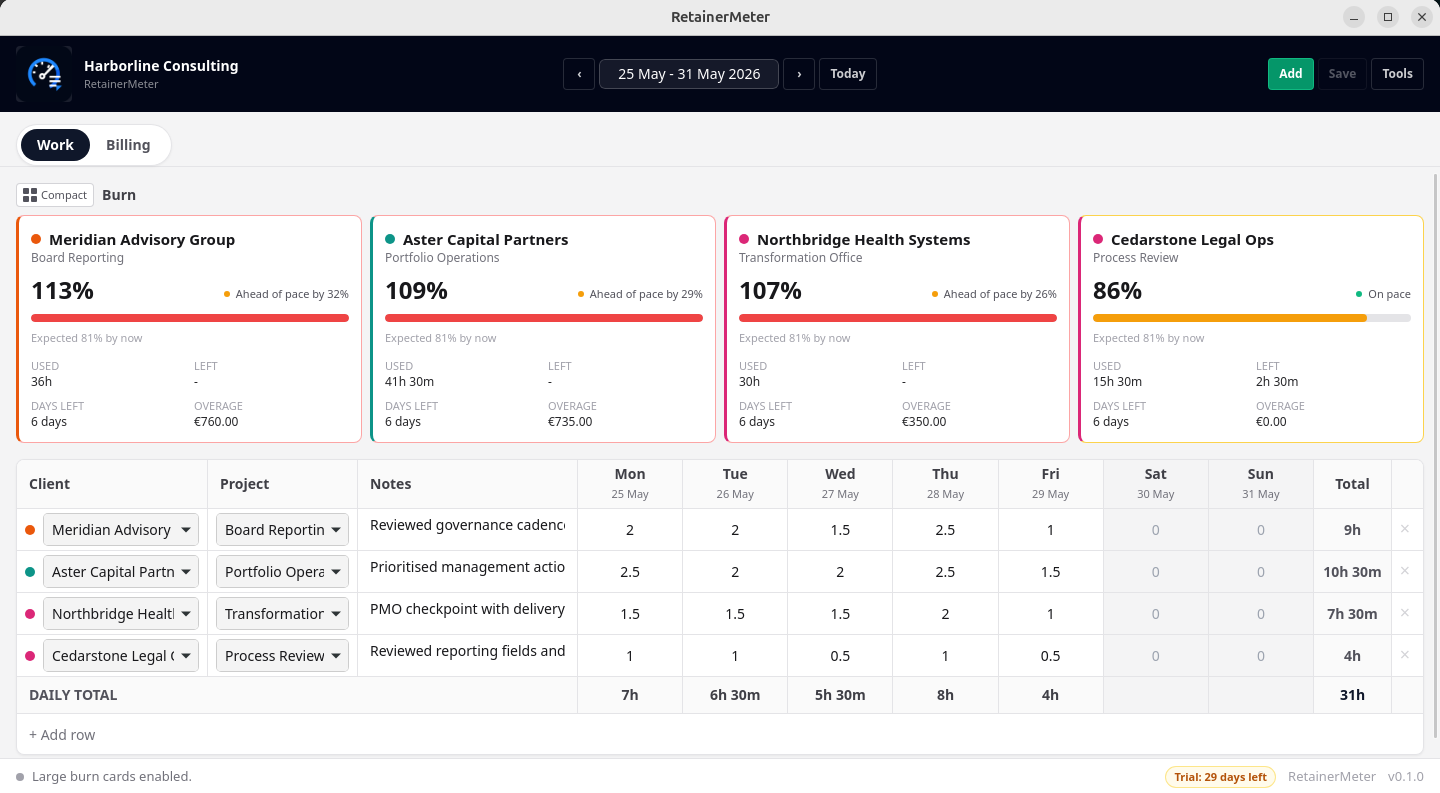
A clearer operational view across recurring client roles
A fractional executive may divide a week among several organisations, each with different access expectations, included hours, priorities, and rules for work beyond the retainer. A calendar or timer records activity, but it does not automatically show whether one client's allowance is nearly gone while another is comfortably on pace.
RetainerMeter keeps the commercial terms beside the time record. Each client can have its own billing model, monthly fee, included hours, additional-hours rate, currency, tax settings, projects, and notes. The burn view then shows hours used, hours remaining, percentage consumed, and pace for the point reached in the month.
One workflow from client terms to invoice
1. Record each engagement
Set the recurring fee, allowance, billing model, and additional-hours rate agreed with that client.
2. Log the work
Enter time by client and day, with projects and notes for the activity record you need.
3. Check retainer pace
See which engagements are ahead of expected usage before month-end creates a scope or billing surprise.
4. Prepare the billing record
Preview the retainer fee, approved additional hours, tax, payments, and balance before PDF export.
Useful across different fractional disciplines
The app does not impose a CFO, COO, CMO, or CTO methodology. It provides the same narrow retainer controls underneath whichever fractional service you sell:
Fractional CFO and finance leadership
Separate recurring advisory work from approved hours beyond the monthly allowance, using projects and notes for the service categories relevant to the engagement.
Fractional COO and operations leadership
Keep operational reviews, delivery oversight, and implementation work attached to the correct client and billing period.
Fractional CMO and commercial leadership
Track recurring strategy and oversight time without turning campaign management or marketing delivery into a generic task system.
Fractional CTO and technology leadership
Record advisory, planning, and technical oversight time while keeping each client's allowance and additional work visible.
Choose the billing model that matches the agreement
RetainerMeter supports hourly billing, a flat monthly retainer, and a retainer with additional billable hours. Included hours can represent a defined allowance, or time can remain an internal delivery and profitability signal when the client buys access, continuity, or scope rather than a fixed block of hours.
Rollover, approval, availability, and scope rules still belong in the client agreement. RetainerMeter records the operational inputs and applies the configured billing model; it does not invent commercial terms or decide whether additional work was authorised.
Know when the conversation should happen
If an engagement has consumed most of its allowance halfway through the month, waiting for invoice day is too late. Live burn and pace can prompt an earlier decision: re-prioritise the remaining work, clarify what is in scope, or request approval for additional hours. This is especially useful when the same person is balancing several client leadership roles.
Local-first software for an independent practice
Normal time tracking, burn calculations, client records, and invoice generation happen on your computer. There is no required cloud workspace and no account needed for daily use. Internet access is used for functions such as update checks, downloads, and online licence activation—not for storing ordinary client time data.
RetainerMeter is best suited to an independent fractional executive or a small practice where one person owns the time and invoicing record. It is not a client portal, employee-monitoring system, team scheduler, CRM, payroll tool, or full accounting suite.